
Learn how a portable Wi-Fi ultrasound scanner can detect abdominal aortic aneurysms. Explore handheld ultrasound devices, clinical applications, and the advantages of mobile ultrasound for primary care and emergency settings.
Introduction
Abdominal aortic aneurysm (AAA) is a silent yet potentially life-threatening condition. Most patients remain asymptomatic until the aneurysm reaches a critical size or ruptures, making early detection essential. Timely identification of AAA reduces morbidity and mortality and supports preventive cardiovascular care.
Traditional AAA diagnosis relies on stationary ultrasound systems in specialized diagnostic departments. However, access to such equipment can be limited in primary care clinics, rural settings, or mobile healthcare scenarios.
Modern technology has introduced portable Wi-Fi ultrasound scanners, including handheld devices compatible with smartphones, that allow clinicians to perform real-time imaging during routine check-ups. These devices provide mobility, rapid deployment, and sufficient diagnostic accuracy for early AAA detection, transforming the standard of care in primary and emergency medicine.
This article presents a clinical case where a portable Wi-Fi ultrasound scanner enabled early detection of an abdominal aortic aneurysm in an asymptomatic patient, highlighting its diagnostic value, workflow efficiency, and practical applications in everyday clinical practice.
Clinical Case: Early Detection Using a Portable Wi-Fi Ultrasound Scanner
A 47-year-old male patient underwent a routine preventive examination with a general practitioner.
- Patient Profile
- Age: 47 years
- Sex: Male
- Medical history: arterial hypertension for over 8 years.
- Therapy adherence: irregular antihypertensive medication
- Lifestyle: active smoker
- Symptoms: none
Despite the absence of complaints, the patient had multiple cardiovascular risk factors. Given the age, sex, and history of hypertension, the physician decided to perform a full abdominal examination, including the abdominal aorta, using a portable Wi-Fi ultrasound scanner.
The handheld ultrasound device was connected to a smartphone, demonstrating the growing trend of clinicians exploring wireless ultrasound solutions in primary care.
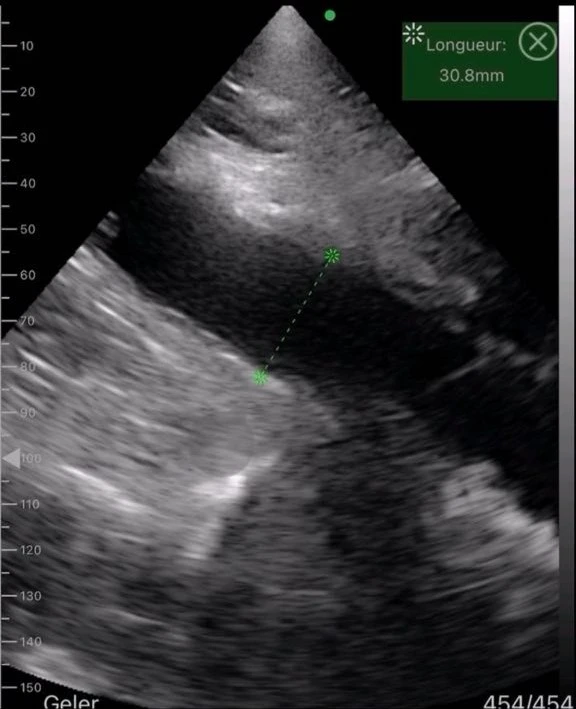
Ultrasound Examination Methodology
The examination was performed using a convex portable ultrasound device with wireless connectivity.
Technical Details
- Real-time imaging transmitted via Wi-Fi to a smartphone
- Standard B-mode imaging for vessel assessment
- Doppler evaluation of blood flow
- Handheld design suitable for outpatient use
Scanning Protocol
- Longitudinal and transverse scans of the abdominal aorta
- Focus on infrarenal aortic segment
- Measurement of anterior-posterior diameter
- Evaluation of vessel wall structure and lumen
- Assessment of blood flow and Doppler patterns
Why Portable Wi-Fi Ultrasound Scanners Are Effective A portable Wi-Fi ultrasound scanner is highly suitable for evaluating the abdominal aorta.
Technical Suitability
- Adequate imaging depth with standard convex probes
- Real-time visualization of vessel structure and flow
- Longitudinal and transverse scanning capabilities
Clinical Advantages
- Rapid bedside assessment
- Early detection of asymptomatic conditions
- Reduced referral delays
- Integration into primary care workflow
Clinicians can also see our ultrasound equipment catalog to explore different handheld ultrasound solutions for clinical practice.
Applications in Primary Care and Emergency Medicine
Portable ultrasound scanners have expanded point-of-care diagnostic capabilities.
Use Cases
- Routine preventive screenings
- Emergency diagnostics
- Initial differential diagnosis
- Monitoring high-risk patients
Benefits
- Immediate availability at the point of care
- Improved clinical decision-making speed
- Reduced need for specialized infrastructure
- Enhanced patient engagement and satisfaction
Portable Wi-Fi ultrasound devices enable mobile, outpatient, and home-based diagnostic scenarios, increasing accessibility for general practitioners, emergency physicians, and field medical teams.
Advantages and Limitations
Advantages
- High mobility and portability
- Immediate imaging during consultations
- Sufficient accuracy for AAA screening
- Integration with smartphones and tablets
- Cost-effective alternative to stationary systems
Limitations
- Limited advanced imaging modes compared to stationary systems
- Operator-dependent results
- Not suitable for highly complex imaging studies
Despite these limitations, portable ultrasound scanners provide reliable early detection and monitoring capabilities.
Sante Integrale Portable Ultrasound Solutions
Sante Integrale provides portable Wi-Fi ultrasound scanners widely adopted by clinicians across multiple specialties.
Target Users
- General practitioners
- Cardiologists
- Surgeons
- Emergency physicians
- Mobile and field healthcare teams
Devices from Sante Integrale are designed for real-world clinical applications, including outpatient and mobile settings. Their adoption supports modern point-of-care diagnostics in diverse clinical scenarios.
Comparison: Portable vs Stationary Ultrasound Systems
Feature | Portable Wi-Fi Ultrasound Scanner | Stationary Ultrasound System |
Mobility | High | Low |
Setup Time | Immediate | Requires setup |
Image Quality | High (screening-level) | Advanced |
Accessibility | Point-of-care | Dedicated room |
Cost | Lower | Higher |
This comparison illustrates why portable ultrasound scanners are increasingly adopted in primary care and emergency settings.
Conclusion
This clinical case demonstrates that a portable Wi-Fi ultrasound scanner effectively detects abdominal aortic aneurysms during routine examinations. Identifying a clinically significant condition in an asymptomatic patient underscores the diagnostic value of portable ultrasound devices.
By improving accessibility, supporting early detection, and enabling timely clinical decisions, portable ultrasound scanners have become essential tools in modern medical practice. Equipment provided by Sante Integrale reflects current standards in ultrasound diagnostics, where mobility, efficiency, and accessibility are key factors.
Frequently Asked Questions
1.Can a portable Wi-Fi ultrasound scanner detect an abdominal aortic aneurysm?
Yes, a portable Wi-Fi ultrasound scanner accurately measures the abdominal aorta and detects aneurysmal dilation during routine screenings.
2. How accurate is a portable ultrasound scanner compared to stationary systems?
Portable scanners provide sufficient accuracy for screening and early detection, while stationary systems offer more advanced imaging options.
3. Is a handheld ultrasound device suitable for primary care?
Yes, handheld devices are widely used for point-of-care diagnostics in primary care, emergency medicine, and mobile healthcare settings.
4. Can portable ultrasound devices be used for preventive screening?
Yes, they are effective for early detection of asymptomatic vascular conditions such as abdominal aortic aneurysms.
5. Who benefits most from portable ultrasound scanners?
General practitioners, emergency physicians, and clinicians in mobile healthcare settings gain the most benefit.
6. Does a portable ultrasound scanner replace stationary systems?
No, portable devices complement stationary systems and are primarily used for screening, monitoring, and point-of-care diagnostics.