
The rapid evolution of ultrasound equipment has significantly expanded the role of medical imaging in everyday clinical practice. Today, portable ultrasound and handheld ultrasound devices enable clinicians to perform immediate diagnostics directly at the bedside.
In particular, POCUS (point-of-care ultrasound) has become a key tool for fast clinical decision-making. This case demonstrates how wireless ultrasound technology was used to confirm gallstone disease in a real clinical setting without delay.
Innovation in Ultrasound
Recent ultrasound innovations have transformed traditional diagnostic approaches. Modern systems combine high image quality with portability, allowing clinicians to perform examinations in real time across multiple care settings.
Key innovations include:
▪️compact portable ultrasound systems
▪️wireless data transmission
▪️integration with mobile devices
▪️enhanced imaging algorithms
These technologies have redefined medical imaging, making diagnostics faster and more accessible.
Portable Ultrasound Trend
The global demand for portable ultrasound continues to grow due to the need for rapid diagnostics and workflow optimization.
Handheld ultrasound systems provide:
▪️immediate bedside assessment
▪️reduced diagnostic delays
▪️improved patient management
▪️flexibility across clinical environments
Healthcare professionals can learn more about portable ultrasound systems to better understand their role in modern diagnostics.
Doppler Technologies
Modern doppler ultrasound capabilities are increasingly integrated into portable systems. This allows clinicians to assess blood flow and vascular conditions even outside traditional imaging departments.
Applications of doppler ultrasound include:
▪️evaluation of vascular perfusion
▪️detection of flow abnormalities
▪️support in differential diagnosis
Wireless Probes
Wireless ultrasound probes represent a major advancement in ultrasound technology. These devices transmit images directly to smartphones or tablets, enabling full mobility.
Advantages include:
▪️cable-free operation
▪️real-time imaging on mobile devices
▪️high flexibility in clinical use
▪️suitability for POCUS
Clinicians can explore wireless ultrasound scanners to integrate these solutions into practice.
AI in Ultrasound
Artificial intelligence is becoming an important component of ultrasound equipment, improving both workflow and diagnostic accuracy.
AI supports:
▪️automated measurements
▪️image optimization
▪️decision support
This further enhances the value of medical imaging in clinical environments.
Applications
Clinical Case Overview
A 74-year-old female patient presented with acute pain in the right upper quadrant. The pain radiated to the right shoulder and was associated with nausea, vomiting, and general weakness.
Symptoms occurred after fatty meals and lasted several hours, suggesting gallbladder pathology.
Point-of-Care Ultrasound (POCUS)
A portable ultrasound examination was performed using a handheld ultrasound device with a wireless probe.
This point of care ultrasound (POCUS) approach allowed:
▪️immediate imaging
▪️real-time clinical decision-making
▪️elimination of diagnostic delays
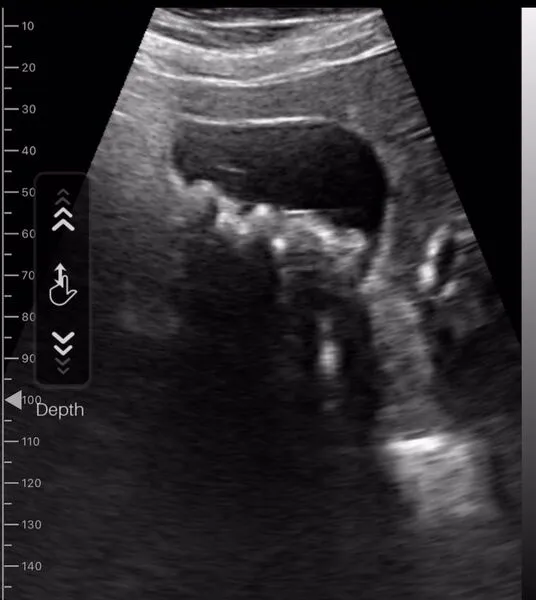
Ultrasound Findings
The ultrasound imaging revealed:
▪️gallbladder with normal shape
▪️multiple hyperechoic structures
▪️clear posterior acoustic shadowing
▪️mobility of structures with position change
▪️mild thickening of the gallbladder wall
These findings are characteristic of gallstones and confirm gallstone disease. No bile duct dilation was observed.
Clinical Interpretation
Based on clinical presentation and portable ultrasound findings, the diagnosis was established: Gallstone disease with multiple calculi and biliary colic.
The use of POCUS enabled rapid confirmation and timely clinical decision-making.
Role of Portable Ultrasound in Practice
This case demonstrates that handheld ultrasound provides sufficient diagnostic accuracy for abdominal pathology.
Clinicians can:
▪️perform immediate diagnostics
▪️improve workflow efficiency
▪️enhance patient outcomes
Healthcare providers can see our ultrasound equipment catalog to explore available diagnostic solutions.
Conclusion
Modern ultrasound equipment, including portable ultrasound and wireless ultrasound systems, plays a crucial role in contemporary medicine.
This clinical case confirms that POCUS is a reliable and efficient method for diagnosing gallstone disease. The integration of doppler ultrasound, mobility, and advanced imaging technologies continues to transform medical imaging.
Solutions available from Sante Integrale are widely used in clinical practice and support high-quality diagnostics in various medical fields.
Frequently Asked Questions
1. What is a portable ultrasound diagnostic tool?
A portable ultrasound diagnostic tool is a compact imaging device used for real-time diagnostics at the point of care, including emergency and outpatient settings.
2. How does POCUS improve diagnosis?
POCUS (point of care ultrasound) allows clinicians to perform immediate imaging during patient evaluation, reducing time to diagnosis and improving outcomes.
3. Is handheld ultrasound accurate for gallstone detection?
Yes. Handheld ultrasound devices provide sufficient resolution to detect gallstones and assess gallbladder condition.
4. What are the benefits of wireless ultrasound systems?
Wireless ultrasound systems offer mobility, ease of use, and real-time imaging on mobile devices, making them ideal for modern clinical workflows.
5. When is doppler ultrasound used?
Doppler ultrasound is used to assess blood flow and vascular conditions, supporting diagnosis in multiple clinical scenarios.
6. Who uses portable ultrasound systems?
Portable systems are used by physicians in emergency medicine, internal medicine, surgery, and outpatient care.